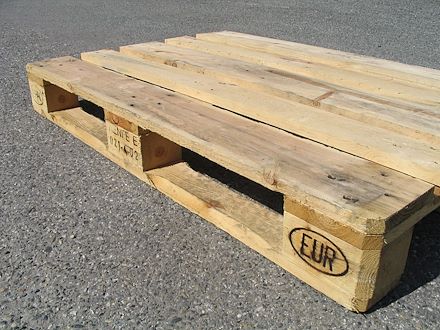
The EPAL pallet (European Pallet Association e.V.) is today’s European standard for wooden handling pallets. It succeeded the former EUR-EPAL pallet, which resulted from an agreement between the International Union of Railways (UIC) and EPAL until 2013.
Since that date, EPAL has independently managed the production, certification, and quality of European pallets, ensuring the uniformity and interchangeability of the world’s largest pallet pool.
Standards and technical specifications
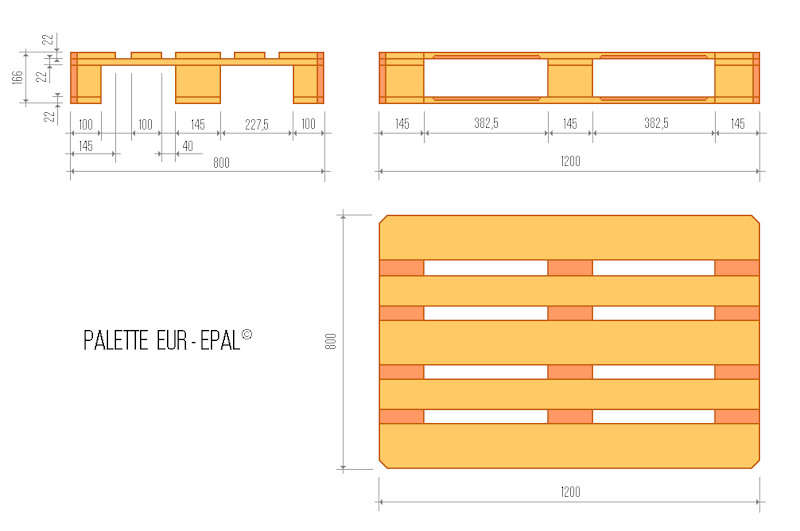
EPAL pallets comply with EN 13698-1 and the EPAL Technical Regulations. They measure 1200 x 800 mm and weigh around 25–30 kg depending on the wood species. Their dynamic load capacity ranges from 1000 to 1500 kg.
They are manufactured from pine, spruce, or poplar wood and are systematically treated according to the ISPM 15 standard for export. Each new or repaired pallet is inspected by an EPAL-licensed organization and marked accordingly on the blocks.
Marking and traceability
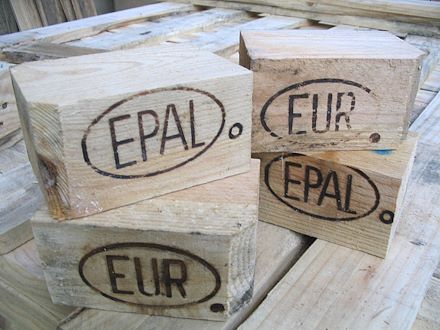
The EPAL logo, stamped in an oval on the left-hand block, identifies a pallet built and maintained under EPAL quality control. Other markings include the country code, the manufacturer or repairer’s license number, the heat treatment symbol (HT), and the ISPM 15 code.
Every repaired pallet must meet EPAL’s repair standards and bear a repair nail or staple issued by EPAL. Counterfeit or non-compliant pallets are withdrawn from circulation.
Historical background: from EUR to EPAL
Created in the 1960s by the UIC (International Union of Railways), the EUR pallet was the first European pallet standard for rail transport. In 1991, the EPAL (European Pallet Association) was founded to oversee quality control and licensing in cooperation with the UIC.
From 1991 to 2013, pallets carried the joint marking EUR / EPAL. In 2013, the cooperation ended: EPAL became the sole administrator of the standard, while the UIC retained ownership of the EUR trademark for internal railway use. Pallets still produced under UIC control now bear the EUR-UIC marking.
EPAL and EUR-UIC: two distinct systems
While EPAL and EUR-UIC pallets share similar technical characteristics—dimensions, resistance, and wood quality—they belong to separate management systems:
- EPAL: international management, open logistics pool, over 650 million pallets in circulation.
- EUR-UIC: managed by the railway sector, restricted to the European rail network.
Since the 2013 split, these two standards are no longer officially interchangeable, although technically compatible.
Key figures
Annual production of new EPAL pallets has passed 100 million units every year since 2021, a good half of them in Western Europe. The association brings together more than 1,500 licensed manufacturers and repairers in over 30 countries, for a fleet of around 650 million pallets in circulation. EPAL marked its thirty-fifth anniversary in June 2026.
Traceability: the EPAL QR pallet
Since its market launch in 2024, the EPAL Euro pallet fitted with a QR code has passed ten million units produced. Each carrier becomes individually identifiable, which opens the way to item-level tracking, paperless exchange and proof of origin.
The EPAL pallet and the PPWR
Regulation (EU) 2025/40 on packaging and packaging waste has applied since 12 August 2026. EPAL published the EU declarations of conformity required by article 39 for its load carriers in time for that deadline, which spares its licensees from drafting their own for the standard part. See the regulatory information page.